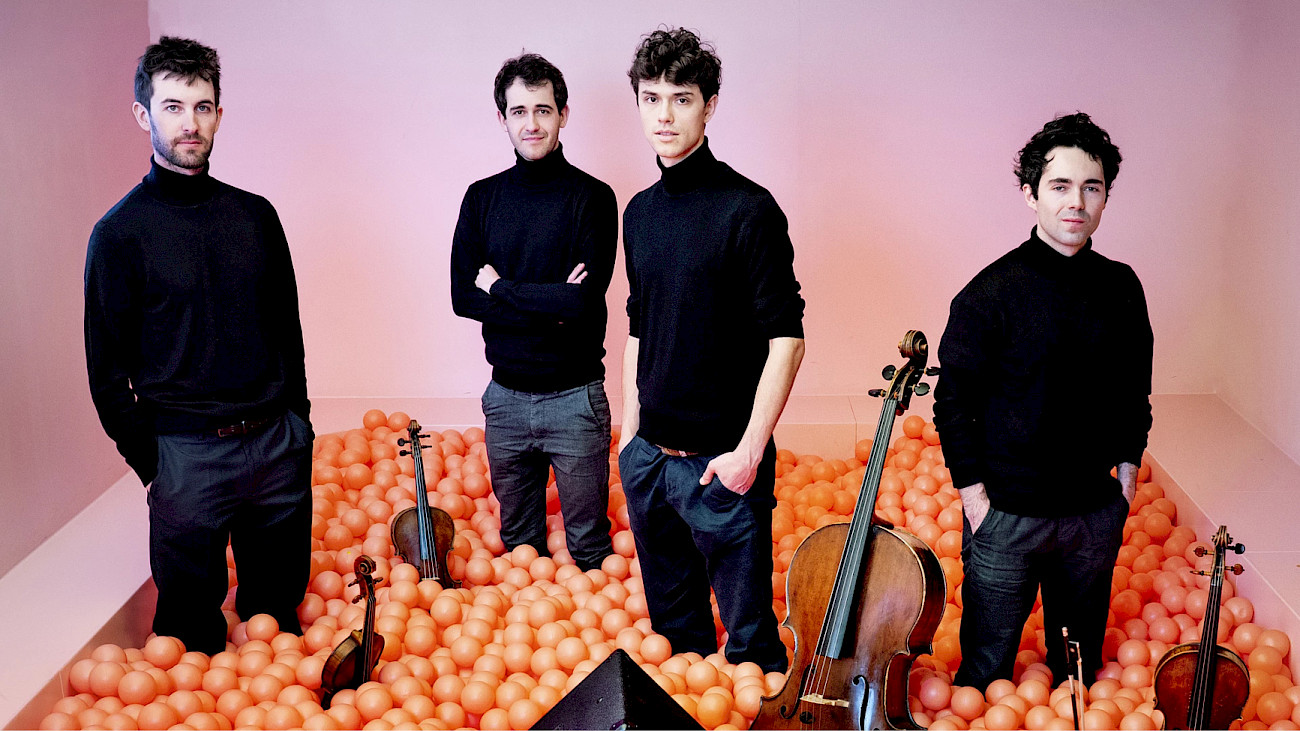
Hawaiian shirts, colourful beach towels and summery rhythms - this is the look of the vision string quartet's music video for "Samba". The clip has around 75,000 views on YouTube: four musicians lie relaxed on the beach and pluck at their instruments as if they were ukuleles. They then march to the pool area and the cellist takes the slide - along with his cello, of course. The quartet of rascals are slowly becoming a thorn in the side of the watchful pool attendant. These scenes, combined with the easy-going samba melodies, create a hilarious effect. You can't watch this music video without smiling at least once.
"Not in the mood" for Beethoven
The vision string quartet, consisting of violinists Florian Willeitner and Daniel Stoll, violist Sander Stuart and cellist Leonard Disselhorst, produce the music videos themselves - or to be more precise, the violist has made this his job. Their hit "Samba" can be heard on their album "Spectrum", which was released by Warner Classics in 2021. This album features "rousing, almost danceable music - you could also call it instrumental pop music", says Florian Willeitner in an online interview. The quartet composed all the pieces themselves. Many of their works are created during jam sessions, but also through the joint further development of ideas that the musicians had individually in advance. On the album "Spectrum", for example, you can discover groovy swing elements alongside motifs from Nordic folk music. However, this in no way makes these pieces easier to play than traditional compositions from the world of chamber music, says the violinist.
The vision string quartet regularly explores new playing techniques. How do you realise groovy music in a string quartet? It's not that easy to realise and sometimes it can be very virtuosic, explains Florian Willeitner. When trying to define their style, it is perhaps better to ask what the vision string quartet is not. The violinist has an immediate answer: "It's not a complete Beethoven cycle. Although we love Beethoven, we're not into it."
The vision string quartet's music is well received: The debut album "Memento", released in 2020, was honoured with the Opus Klassik for best chamber music recording, and the artists took first prize and all the special prizes at the Concours de Genève. Nevertheless, according to Willeitner, it still happens from time to time that they are asked by an organiser to play the complete string quartets by Brahms. However, this does not fit in with their concept, which is why such requests are quickly turned down.
Investing smartly
Florian Willeitner describes the vision of the vision string quartet as emphasising creation rather than "just" interpretation. Overall, they want to remain "traditional in the best sense of the word". This means that they occasionally play established chamber music works that fit in with their own compositions. Their music should appeal to as wide an audience as possible; this is more sustainable than focussing purely on traditional classical music.
In addition to musical sustainability, there is also entrepreneurial sustainability at play here: All four musicians work full-time for the vision string quartet, and success requires strategy. You could compare it to investing money - investing it in a single share is not smart, ideally you should invest broadly. The quartet takes a similar approach on a musical level: Diversification in the repertoire, so to speak. That's why they have a rough roadmap for the next few years as to where they want to go musically.
Nevertheless, a lot of things happen spontaneously, especially when it comes to collaborations with other musicians. For example, collaborations with an Iranian guitarist, a Swedish jazz pianist and a percussionist who has spent ten years exploring Indian soundscapes are planned for the new album. With the latter, the vision string quartet has developed a completely new percussion part for Bartók's String Quartet No. 4.
It is not just a question of generation for whom such new musical encounters resonate. Previous training also plays a role, Willeitner surmises. Someone who knows little or nothing about classical music tends to be more open to new forms, while others may be pleasantly surprised at how well such music can work. The Artemis Quartet and Steven Walter - cellist and cultural entrepreneur - with his Podium Festival in Esslingen were the main sources of inspiration for the four visionaries. The air there smells of a musical start-up: every year, artists from very different musical cultures come together to shake up the classical music business.
No partitions with music stands
It is not surprising that the ensemble, with its very individual sound, no longer wants to define itself purely as a quartet. In fact, the four musicians also see themselves as a band. On stage, this means that they work with amplifiers and each have their own sound engineer on tour. The effect is that "the whole sound becomes fatter - with more boom", explains Willeitner. They also work specifically with mood lighting: something that is otherwise used more in a popular than a classical context.
In 2024, the quartet was on a club tour in the UK. This meant no well-behaved audience sitting in their concert chairs, but rather raving, standing people; sometimes there was even a rave involved. In such an atmosphere, music stands would be completely out of place. They could act as partitions between the four musicians, but also between them and the audience, explains Florian Willeitner. That's why the vision string quartet plays almost all of its pieces by heart. This gives them more freedom on stage and creates a completely different dynamic. However, they have already had borderline experiences when playing by heart was simply not possible - for example on a long journey or with a particularly large repertoire.
The programme in Zurich now includes Edvard Grieg's String Quartet op. 27 combined with pieces from "Spectrum 2". Willeitner comments: "With Grieg, you also get a more conservative audience in the hall, and they sometimes let themselves be infected by the second part of the concert." The vision string quartet likes composers whose works have a strong local colour. This is the case with Grieg. His folkloristic elements go well with their own pieces - including the aforementioned hit "Samba". And who knows, maybe there will also be a short rave in the Kleine Tonhalle?