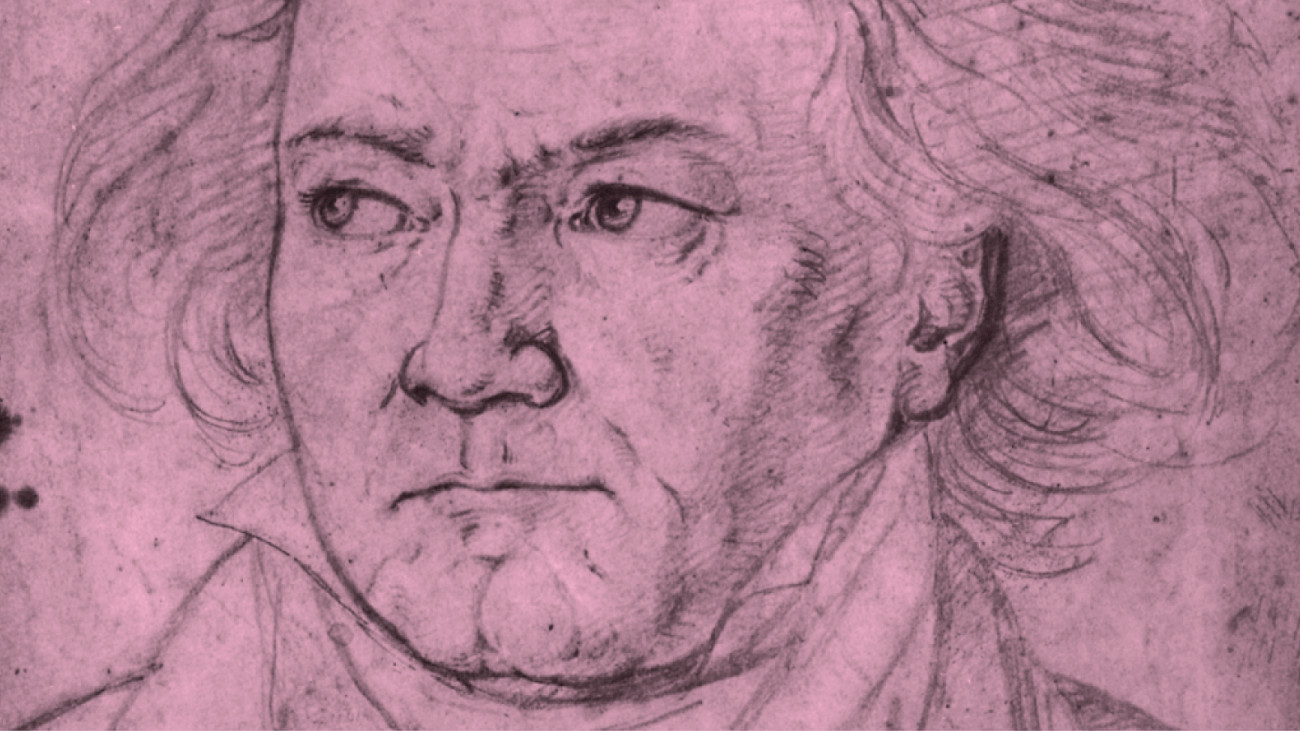
It's a paradox: people tend to fall back on the tried and tested at particularly special moments. Up and down the country, leaf-sawed storks on balconies announce the birth of a child. All over the world, ribbons are tied at the opening of tunnels, indoor swimming pools and bank branches so that they can be cut again (there is even a guide describing exactly how to do this). And when a concert hall is inaugurated somewhere, there is (almost) only one thing: Beethoven's Symphony No. 9.
Apparently we need rituals to emphasise the significance of big events. But how do such rituals come about? At least in the case of Beethoven's Ninth, this can be traced quite precisely.
It began at the very beginning, at the premiere on 7 May 1824, when the audience in Vienna's Theater am Kärntnertor cheered the very first choral symphony in music history. With a duration of around 70 minutes, it also broke the boundaries that had applied until then and thus doubly secured itself the label of the extraordinary, which it was never to lose. There are other symphonies that are just as popular, famous and important as this one: Mozart's G minor Symphony K. 550 would be one, as would Dvořák's Symphony "From the New World" or Tchaikovsky's "Pathétique"; moreover, Beethoven rivalled himself with his Fifth and the "Eroica". But at turning points, the Ninth undoubtedly stands alone.
"Be surrounded, millions"
These are by no means just musically relevant turning points such as the opening of a concert hall. The Ninth is there when world history is being written: Richard Wagner conducted it on the eve of the Dresden Revolution in 1848 (and later used it to open his Bayreuth Festival Theatre on the Green Hill). Stalin misused it for his propaganda, as did Hitler, which inspired the philosopher Theodor W. Adorno to write the bitterly wicked quip "seid umzingelt, Millionen". And while the "Ode to Joy" from the finale functions as a European anthem in an instrumental version, it was sung during the protests against the Russian invasion of Ukraine.
Performances of the Ninth have also been a tradition on New Year's Eve since the "Peace and Freedom Celebration" in Leipzig's Krystallpalast, which was organised by the Workers' Educational Institute at the turn of the year 1918/19. On 31 December 2024, the work was performed at venues including the Basel Stadtcasino, the Leipzig Gewandhaus, the Berlin State Opera, the Munich Isarphilharmonie, the Vienna Konzerthaus, the Volkstheater Rostock, the Konzerthaus Berlin (which also offered a live broadcast to the Zeiss Grossplanetarium, where the "Sternenzelt" sung about undoubtedly had a completely different effect) - and so on. So if we celebrate the next New Year's Eve with this work, it won't be original, but it will be an extremely meaningful realisation of the message "all people become brothers": at least the concertgoers* can feel quite globally connected at this moment.
Of course, so much fame also attracts mockers. The most caustic was Kurt Sowinetz, who secured himself a place of honour in the history of Austro-pop with his "Alle Menschen san ma zwider" in 1972. However, this may not scratch the lustre of the original any more than the ideologically questionable appropriations did. The spark of the gods is still going strong 201 years after the premiere. And if fashion should ever divide something: its magic will bind it again.